
University of Minnesota – Duluth students in David Beard’s Minnesota Writers class interviewed local writers and wrote spotlight articles that we will showcase in the coming months.
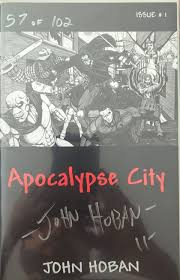
Students are filing out of Denfeld High School, eager to get home. It’s conference day, though the school has a new format, with teachers seated in the cafeteria waiting for parents. Born in Chicago, John Hoban first brings me to the computer lab where I had once taken a class of his, art of photo and cinema. The room has many more posters than I remembered it having, he tells me they’ve got new computers, I see examples from the same projects I was doing. We head to his class, still a museum, only with even more on display. Countless posters, action figures, art, both his own and students’, paint every corner. Nowhere is absent from creation. On one of the many tables sits a piece he’s working on, a woman’s face in pencil. I ask him what of his artistry is Minnesotan. He says I stumped him. “I have an origin for one of my characters who is from Duluth…but it [the story] takes place in Chicago, which is where I was originally born. So I guess because most of my life was bridged between Chicago and Minnesota…my work is very much that as well…I don’t like do a lot of lift bridge stuff or anything like that…the imagery isn’t there, but i guess the sensibilities are you know, maybe some of the humor too.” An art teacher for both physical and digital art at Denfeld, John Hoban is also the author, artist, and creator of his own original comic series, Apocalypse City, which he self publishes, attending conventions to sell his comics. He sees it as the best for him personally. “You’re not doing it for a paycheck, you’re doing it because you enjoy it.
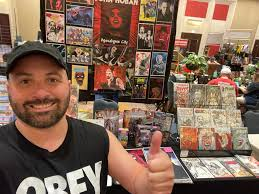
“Like I’ve always walked by a bridge on 8th street and I’m like, that would be, I could always imagine somebody having a really bad day, like sitting on the edge of that bridge, you know, looking down at the water.” We continue, both of us as creatives talking on how Minnesota physically manifests in our stories. “I remember seeing an apartment building and I was wondering, well, what would it look like if there was a conversation going on in that one window, but then you saw, like some kind of creature floating, looking in the window?” For Hoban, art is for the self, to share with others, yes, but something to be free of financial or corporate influence.
His love for horror and comics, the genre and medium he partakes in the most, came from his childhood. He tells me of times with his aunt where she would play Halloween music to scare him and his brother, of the movie series Halloween and how he and his brother would watch the VHS collection on repeat late into the night. The feeling of not being able to even get up to turn the TV off they were so scared. “We still enjoyed that feeling, and I feel like I still try to get that feeling by going to see horror movies because it made you feel something…anytime a movie or piece of art makes you feel something, that’s probably the height, right?”
He describes Apocalypse City as very ‘90s influenced, “it’s like if the Avengers, the X-Men, and they were just supernatural, and they weren’t like superheroes.” Book one, which he says can be found at local shops like Collector’s Connection, is just the beginning, with book 2 in progress, with plans to collect it into a graphic novel. We find a moment of real artistic connection when speaking about freedom as an artist in relation to him being both the artist and writer. “It’s so convenient…there’s no conflict between what the writer’s thinking and what the artist’s thinking. I can change it anytime I want.”
As Hoban was my former art teacher, I asked for some artistic advice, the best he could give me or any upcoming artist. “Turn your brain off.” Allow yourself to be free of your own judgement.
I asked what he found hard about being an artist in Minnesota. Hoban brought up exposure, audience, but it seemed to me that artistry and writing was about something more. He talks about his family, his full time job, and that going all in on being an independent artist who lives on their work isn’t in the cards for him. But from what he told me, he didn’t want it. For him, it was about his specific role as an art teacher. “When kids explore…if there’s an artist and you…teach them how to do this and how to do that, then they have all these other tools in their toolbox, then al of a sudden, the trees start to branch out and it gives them more paths and more avenues to think creatively. And that’s what I want to develop with all the kids.”
“So I love teaching and I wouldn’t give it up for anything.” Duluth is a quiet place, the land of lakes where he can work, teach, raise a family, and do his art in peace.
Born and raised in Duluth, Minnesota, Lucas Powell is a writer, author, artist, and multimedia producer. With a deep love of storytelling, he enjoys exploring the technical, artistic, and philosophical intricacies of stories and their impacts on individuals and society. When not writing fantasy, fanfiction, or media analysis, he loves playing video games, cosplaying and exploring the world. He lives at home with his family, dog, and two cats.

