
Lessons in Writing and Life from Lynn Wohlwend

University of Minnesota – Duluth students in David Beard’s Minnesota Writers class interviewed local writers and wrote spotlight articles that we will showcase in the coming months. 


I was in a hurry the day that I met Lynn Wohlwend. I was squeezing her in after my eleven o’clock class and before my one o’clock class. By the time I got to Wohlwend’s office I was flustered and flushed from fighting the crowds of students in the hallways. Her office was tidy and neat. Sunlight streamed through the windows in soft rectangles warming the room and cutting through the chaos I had carried with me. It felt like a breath of fresh air after my hectic walk across campus.

Lynn Wohlwend works at the University of Minnesota Duluth as a Writing Studies professor in the College of Arts, Humanities, and Social Sciences. At first glance, her background and education might look a little bit different from most writing and English professors. Wohlwend graduated from the University of Madison Wisconsin with her bachelor’s degree in Zoology and her Master of Science degree in Life Science and Communication. She also received her Master of Fine Arts in Creative Writing from the University of New Mexico. 

Once I learned about her educational journey, I wanted to understand the internal thought behind it. What makes someone change from science to literature? I myself had recently gone through a change from science to English (from nursing school to majoring in elementary education with a minor in English).

When I asked about her decision to move away from science, she explained simply but honestly, “Science was not the right fit for me. I was not happy when I was working in a science lab.” Her tone was calm, but there was a certainty in her voice, an acceptance of a truth she had come to understand over time. She also told me that she enjoyed journalism when she was first getting into the English world.
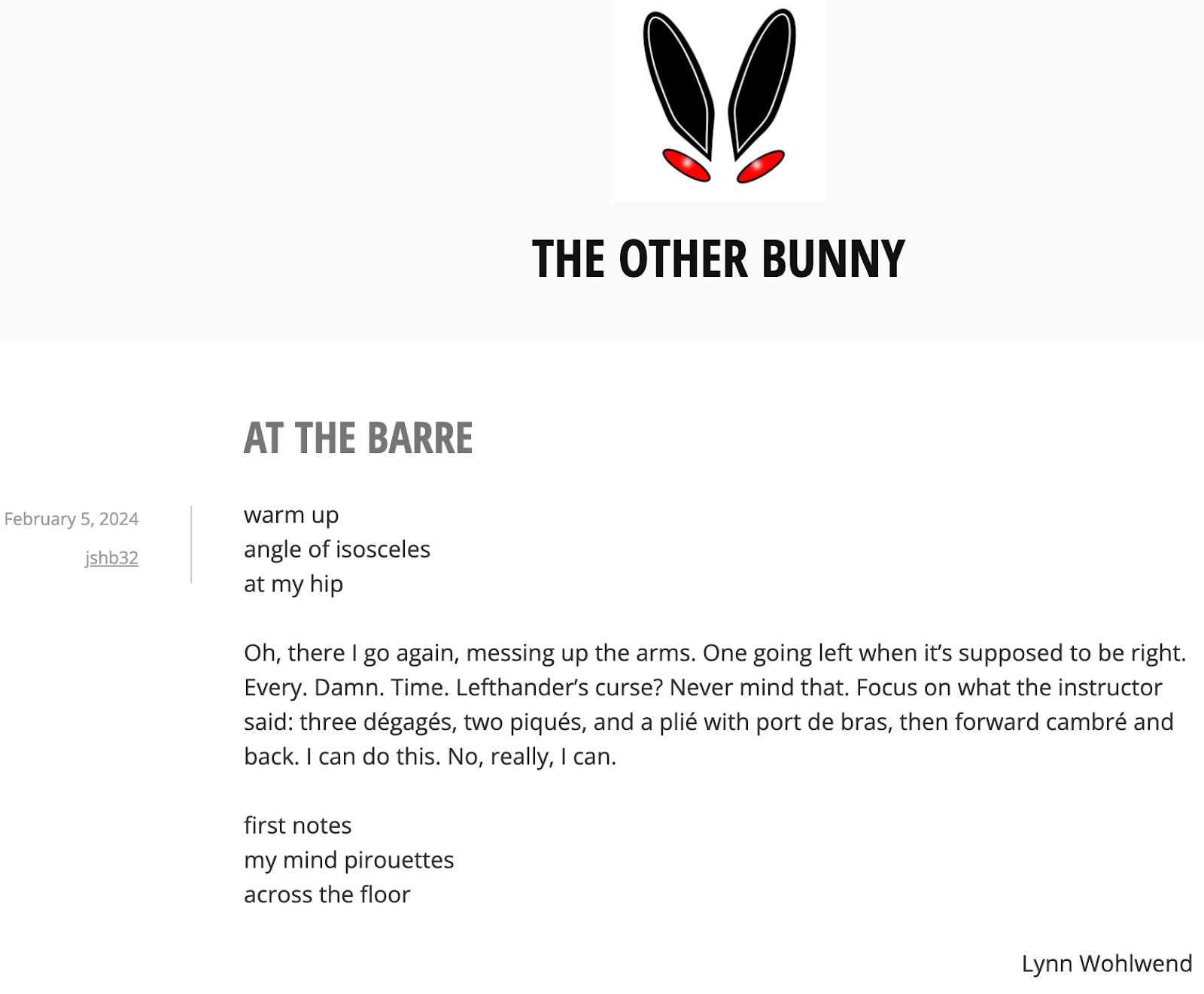
Prior to my interview with Wohlwend, I read her haibun poem titled “At the Barre,” which was published in an online poetry journal called The Other Bunny. A haibun is a traditional Japanese poem that combines prose and haiku poem styles. A haibun normally begins with a paragraph style text with one or more haiku poems following. 

Wohlwend’s haibun was about a person who is attempting to perform ballet. The person performing the ballet is struggling to perfect the different positions being demanded of them. They call it the left-handers curse. The poem was very vulnerable and awkward, which made it easy for the audience to relate to. I was curious about why she chose this form and what drew her to ballet terminology specifically.

Wohlwend told me that she is in ballet. “I joined in my mid-thirties. I must be the oldest person there, but I enjoy going because it is something that I can do for myself that makes me feel good.” She told me she enjoyed playing with the haibun and trying something new both with the haibun and with ballet.

Wohlwend has been working on a novel for quite some time, a project that continues to remind her why she chose writing in the first place.

I asked her if she had any advice for aspiring authors. “Be kind to yourself,” is what she told me. She also told me to keep a steady routine. “Most new writers think that they have to write for an hour a day and they will have it made. This is a good idea in theory, but is completely unrealistic. If you can even write for a few minutes at first, you will build a routine and do just fine.” One piece of advice that I found the most reassuring was when she told me that she is still developing as a writer. “It takes time,” she reminded me.

By the end of our interview, the rush from getting to her office had faded. Meeting with Lynn Wohlwend offered me answers, not just to the questions that I needed to be answered for my assignment but also questions that I had as an aspiring author. She told me about what it means to grow, to change paths, to experiment, and to learn. She has changed careers, interests, and residences – and still made all of them work. She listens to what her heart wants and to what brings her joy. Walking out of her sunlit office, I learned that writing is a lifelong process, not a craft to be perfected.

Cassie Zortman is powered by caffeine and chocolate with a serious shopping addiction. When she is not checking out her cart online, she is reading, writing, or pretending like her TBR pile isn’t judging her. She grew up on a farm in the middle of Minnesota with no wifi. With nothing but open fields and a stack of books, she began dreaming up her stories before she ever wrote them down. Today she still lives in Minnesota (with wifi), a chocolate croissant in reach, a mug of coffee within dangerously elbow-knocking distance, and a cat who believes her lap is the only acceptable place to nap. 

Minnesota Writers Spotlight on Amy Jo Swing by Joseph Bruce Bussey, Jr

University of Minnesota – Duluth students in David Beard’s Minnesota Writers class interviewed local writers and wrote spotlight articles that we will showcase in the coming months. First up is poet, instructor, and Lake Superior Writers Board Member, Amy Jo Swing.


Amy Jo Swing, an instructor at Lake Superior College, sat down with me in the Equity and Diversity Center to talk about her poetry featuring Coloring of Monsters, Crossing it Off, and Wordage. What started as an interview turned into a deep and thoughtful conversation diving into the motivations and inspirations of Amy Jo Swing’s work and her upbringing – along with her wisdom and philosophy. I asked her, “In Coloring the Monsters, you focus on emotions and color theory, speaking of love, anger, and the complexity of it all. What compelled you to write this piece?” 

“I’ve always been an admirer of art. If you ever go to the Rothko Chapel in Texas (I went to college down there), you’ll find pieces of art that are full of color. I wanted to mix my passion with what I admire, because that’s all art really is.” 

The Rothko Chapel (in Houston, Texas), sits as a major work of modern art. Inside, beautiful pieces reign and dominate the walls. Fourteen of Mark Rothko’s paintings are there.  The more and more we conversed, the more and more I realized that if Amy Jo Swing hadn’t become an English teacher, she’d surely become a teacher of art. I then asked her about the second poem, Crossing it Off. Or well, tried to. I was flustered in trying to get my words out of my mouth. “In Crossing it Off, you write about a list that packs a punch out of nowhere. Why’d you construct it like that?” A basic question, I was so embarrassed. But I was surprised by Amy’s laugh. 

“I wanted to emulate a type of poem where the beginning and end are similar. It’s called a pantoum. At the time, a lot was going on in my life. (I think I was just out of graduate school? I don’t recall completely.) But I wanted to mix in the anxiety of being a woman with the day-to-day shopping list.” 

In the poem, Amy Jo Swing sneaks reality into the idea of a shopping list – a metafictional take; a play within a play. The play, of course, is the realistic shopping list that you and I use daily, but Amy Jo Swing adds in a dabble of reality, which does indeed pack a punch when reading it for the first time. The subtle move alludes to the high expectations that society has on women.

Finally, I asked a question concerning Wordage. In the poem, she talks about how she was bullied a lot for not saying words correctly. So I asked, “In Wordage, you talk about how diction and enunciation were of the utmost importance. What would younger-you think if she were to meet present-you and the career you’re in?” This made her genuinely laugh. 

“She’d probably think, ‘What on Earth are you doing?’  It’s a bit ironic, I suppose. But at the same time, words have always been important to me.” 

Amy Jo Swing’s parents were blue-collar workers and instilled in Amy Jo Swing the importance of education and learning. 

I then asked her questions about her process and how she got published. 

“Well, I was lucky. I was part of a poetry group at a young age in Alaska, where they treated me like poet, not some kid who liked to write. I never published work myself (I have tried to, but never was able) but I was part of anthologies. Actually, I brought a copy of an anthology I was a part of. Take a look at the names.” 

I did. On the minimalist white cover were half a dozen names. I recognized one of them, that being William Krueger, another Minnesotan author. She told me to read the names again, and I did, only to find that she worked with Kate DiCamillo. My favorite childhood author. Amy Jo Swing got to publish poetry alongside Kate DiCamillo. I was floored. 

“Okay, now I don’t mean to ask this basic question-” 

“I don’t have to answer it,” Amy Jo Swing replied with humor. 

“True. But what is your writing process?” 

She thought for a moment. 

“I’m a collector. I rarely ever sit down and actually write, I like to experience things and if something comes to mind, I’ll write it down. Then, I take what I’ve written down and make something out of it. Poetry is something that comes from the heart. My thesis advisor in graduate school once told me, ‘Writing poetry won’t save your life, but reading it would.’” 

Saving a life – taking what we do not know or what hinders us or what angers and saddens us and trying to make sense of it. As Kait Rokowski wrote, “Nothing ever ends poetically. It ends and we turn it into poetry. All that blood was never once beautiful. It was just red.”  Amy Jo Swing is a local treasure, taking the chaos around us that is called life and making sense of it. She embodies Walt Whitman’s quote: “We do not read and write poetry because it is cute, we read and write poetry because we are members of the human race. And the human race is filled with passion.” She is a captain charting her own course, cutting her own sails, and unabashedly riding the waves. 

Joseph Bruce Bussey, Jr. is working on his English degree at the University of Minnesota-Duluth. He’s best known for his poetry and essays, receiving praise from scholars and dreamers alike for his adherence and command of words. Talkative and outgoing, Joseph doesn’t shy away from getting to know someone, saying, “Everyone is their own little poem”. Outside of his writing projects, Joseph likes to take long walks in the Lester woods, listen to all kinds of music, and be there for his Lakeside community. Although he has tried to get published, he finds his time better spent sharing his work with friends, family, and online.