
University of Minnesota – Duluth students in David Beard’s Minnesota Writers class interviewed local writers and wrote spotlight articles that we will showcase in the coming months.
When I spoke with Shawna Weaver about Climate Grief, I expected a discussion about the environmental crisis. What I found instead was a much deeper exploration of how grief, denial, and loss shape our emotional and spiritual lives, especially in relation to climate change. Weaver’s book doesn’t just lay out the facts of environmental decline. It examines how these events are experienced on a human level with the fear, sorrow, and occasional hope that accompany living through a world in crisis.
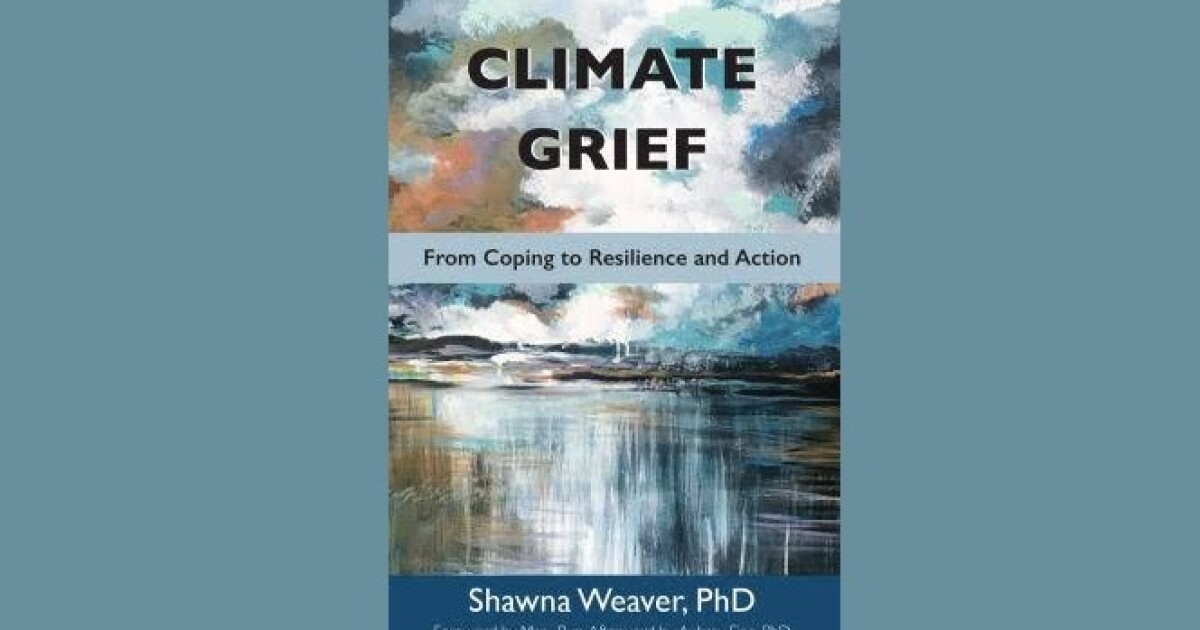
I asked Weaver what first inspired her to frame climate change through the lens of grief. Her answer reflected both her academic background and her professional experience. “During undergrad, I studied the grief process through Kubler-Ross,” she explained. “What really struck me then was how often people get stuck in denial or anger, often without realizing it. Later, when I worked with students experiencing climate grief, I saw how once grief surfaces consciously, it can be used as a tool rather than letting it unconsciously shape behavior.” For Weaver, recognizing and naming grief allows people to navigate it with intention, rather than being passively driven by unacknowledged emotions. Her goal, she said, was to create a space where readers could see themselves, move through their grief, and connect to others experiencing the same.
The book’s strength lies in how it blends personal reflection, psychology, environmental science, and social commentary into a single narrative. Weaver described this integration as a natural outgrowth of years spent living with the material. “By the time I sat down to write, the science, the psychology, and the political context were all integrated in my mind,” she said. “It wasn’t compartmentalized like academic writing. It felt like presenting a decade’s worth of living and working in an honest narrative.” Though this approach required vulnerability, she found that embracing authenticity made the writing process feel both natural and necessary.
A central theme of Climate Grief is hope and the power of action rooted in understanding. Weaver hopes young readers, in particular, will learn to confront truth through grief rather than avoidance. She highlighted Greta Thunberg as an example, whose activism emerges directly from an unflinching understanding of reality. “Avoidance or denial doesn’t help us,” Weaver said. “It only limits the tools we have to respond. Facing grief allows us to see clearly, to make informed choices, and to take purposeful action.” For her, mourning is not passive, but it is a way to engage with reality responsibly and meaningfully.
I also asked Weaver how she maintains her own well-being while writing about such emotionally demanding topics. Her answer highlighted the importance of grounding practices. “Daily routines like running or yoga have become places to practice presence,” she said. “These activities aren’t about checking boxes, but they’re about noticing yourself, connecting with your body, your mind, and your emotions. That grounding is essential. Without it, you risk being pulled under by the weight of the material.” For Weaver, such practices are less about productivity and more about staying connected to the moment and to her own resilience.
Weaver reflected on the intersection of her roles as a writer and counselor, noting how storytelling itself can serve as a form of healing. “Storytelling helps us identify what matters most,” she said, “both for ourselves and for others. Sharing stories opens pathways to empathy and understanding. It helps people see how they arrived where they are and understand others’ perspectives, even when those perspectives differ greatly.” She emphasized that hearing another person’s story can build bridges in conversations that might otherwise become arguments. In the context of climate change, this approach is particularly powerful as it encourages compassion and shared understanding in the face of overwhelming challenges.
Her advice to young writers tackling emotional topics like climate loss, social change, or environmental crisis focuses on starting small and maintaining perspective. “Pick a branch that matters to you and explore it fully,” she said. “You don’t have to take on the whole forest at once. Over time, you’ll see how interconnected everything is, and the larger picture won’t feel as overwhelming. Deep engagement with a single angle allows you to understand the systems at play and tell a story that is both meaningful and realistic.” Weaver stressed the importance of patience and persistence, noting that slow, deliberate work accumulates into understanding that can only come from sustained attention.
Weaver also encouraged writers to ground their work in personal connection. She explained that she chose topics she felt closely connected to, which gave her authority and intimacy in her storytelling. “Even with something as massive as climate change, it helps to find the piece of it you can claim as your own. Once you understand it well, the scope of the issue becomes manageable, and your story becomes stronger because it’s informed by personal knowledge.” Her approach underscores the balance between the vastness of a global issue and the intimacy of personal engagement.
Through Climate Grief, Weaver demonstrates that confronting loss, engaging deeply with emotions, and telling stories is not simply a reflective exercise. It is a way to act in the world, to find grounding, and to help others navigate their own experiences. The book is both a guide for understanding climate grief and an invitation to approach the future with courage, clarity, and conscious awareness. Weaver’s insights reveal that even in the face of global crises, there is space for reflection, connection, and hope, a reminder that understanding our grief is a necessary step toward meaningful action.
Ultimately, Climate Grief is about more than mourning environmental loss. It’s about recognizing the ways grief manifests, using it intentionally, and creating a space to process both personal and collective experiences. In weaving together science, psychology, and personal reflection, Shawna Weaver has written a book that is at once informative, emotionally resonant, and profoundly human.
Remi Foust is a passionate reader of young adult fiction, particularly interested in how book banning affects adolescent education. She is currently studying English, writing, and sustainability, with plans to pursue a graduate degree in library science and English. Remi can often be found at the Kathryn A. Martin Library working as a research peer mentor or at Duluth’s cat cafe, where she doubles as barista and cat caretaker. She has been honored with the English Program Reed Scholarship and the Joseph E. Duncan Scholarship. In her free time, Remi enjoys reading, crocheting, and creatively procrastinating by starting new projects.

