University of Minnesota – Duluth students in David Beard’s Minnesota Writers class interviewed local writers and wrote spotlight articles that we will showcase in the coming months.
I was in a hurry the day that I met Lynn Wohlwend. I was squeezing her in after my eleven o’clock class and before my one o’clock class. By the time I got to Wohlwend’s office I was flustered and flushed from fighting the crowds of students in the hallways. Her office was tidy and neat. Sunlight streamed through the windows in soft rectangles warming the room and cutting through the chaos I had carried with me. It felt like a breath of fresh air after my hectic walk across campus.
Lynn Wohlwend works at the University of Minnesota Duluth as a Writing Studies professor in the College of Arts, Humanities, and Social Sciences. At first glance, her background and education might look a little bit different from most writing and English professors. Wohlwend graduated from the University of Madison Wisconsin with her bachelor’s degree in Zoology and her Master of Science degree in Life Science and Communication. She also received her Master of Fine Arts in Creative Writing from the University of New Mexico.
Once I learned about her educational journey, I wanted to understand the internal thought behind it. What makes someone change from science to literature? I myself had recently gone through a change from science to English (from nursing school to majoring in elementary education with a minor in English).
When I asked about her decision to move away from science, she explained simply but honestly, “Science was not the right fit for me. I was not happy when I was working in a science lab.” Her tone was calm, but there was a certainty in her voice, an acceptance of a truth she had come to understand over time. She also told me that she enjoyed journalism when she was first getting into the English world.
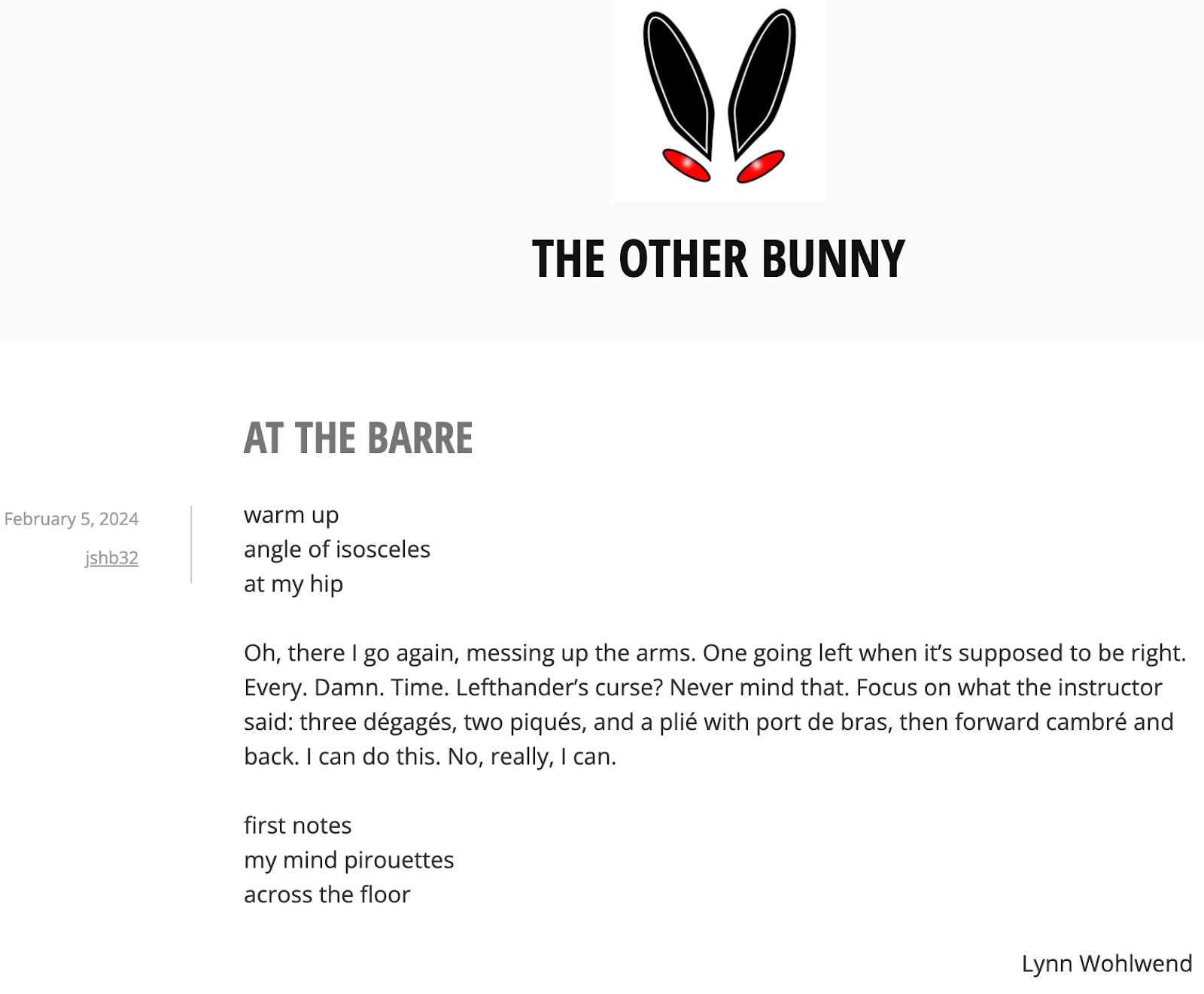
Prior to my interview with Wohlwend, I read her haibun poem titled “At the Barre,” which was published in an online poetry journal called The Other Bunny. A haibun is a traditional Japanese poem that combines prose and haiku poem styles. A haibun normally begins with a paragraph style text with one or more haiku poems following.
Wohlwend’s haibun was about a person who is attempting to perform ballet. The person performing the ballet is struggling to perfect the different positions being demanded of them. They call it the left-handers curse. The poem was very vulnerable and awkward, which made it easy for the audience to relate to. I was curious about why she chose this form and what drew her to ballet terminology specifically.
Wohlwend told me that she is in ballet. “I joined in my mid-thirties. I must be the oldest person there, but I enjoy going because it is something that I can do for myself that makes me feel good.” She told me she enjoyed playing with the haibun and trying something new both with the haibun and with ballet.
Wohlwend has been working on a novel for quite some time, a project that continues to remind her why she chose writing in the first place.
I asked her if she had any advice for aspiring authors. “Be kind to yourself,” is what she told me. She also told me to keep a steady routine. “Most new writers think that they have to write for an hour a day and they will have it made. This is a good idea in theory, but is completely unrealistic. If you can even write for a few minutes at first, you will build a routine and do just fine.” One piece of advice that I found the most reassuring was when she told me that she is still developing as a writer. “It takes time,” she reminded me.
By the end of our interview, the rush from getting to her office had faded. Meeting with Lynn Wohlwend offered me answers, not just to the questions that I needed to be answered for my assignment but also questions that I had as an aspiring author. She told me about what it means to grow, to change paths, to experiment, and to learn. She has changed careers, interests, and residences – and still made all of them work. She listens to what her heart wants and to what brings her joy. Walking out of her sunlit office, I learned that writing is a lifelong process, not a craft to be perfected.
Cassie Zortman is powered by caffeine and chocolate with a serious shopping addiction. When she is not checking out her cart online, she is reading, writing, or pretending like her TBR pile isn’t judging her. She grew up on a farm in the middle of Minnesota with no wifi. With nothing but open fields and a stack of books, she began dreaming up her stories before she ever wrote them down. Today she still lives in Minnesota (with wifi), a chocolate croissant in reach, a mug of coffee within dangerously elbow-knocking distance, and a cat who believes her lap is the only acceptable place to nap.










 Lake Superior Writers